Martech Diary Series | Part 1
Reflections of a marketer navigating marketing automation across local and global organisations.
“All we have to decide is what to do with the data that is given to us.”
— Gandalf, lightly reimagined for martech leadership
Dear Diary,
I’ve spent the last few months thinking a lot about marketing automation.
Not theoretically, but very concretely — as part of several senior martech and marketing leadership interview processes, each looking at the same challenge from a slightly different angle.
Different roles. Different organisations. Different system landscapes.
And yet, the same questions keep resurfacing:
- What would actually make this implementation succeed?
- Why do so many martech programmes stall after go-live?
- And what really creates ROMI — not activity, not dashboards, but durable value?
Once again, the most interesting part wasn’t the technology.
Based on my experience over the years, the pattern is remarkably consistent.
Marketing almost always adapts. Sales, far less so.
Not because they are difficult — but because adoption is rarely designed with them.
So yes, the tools usually work.
But somehow, the organisation doesn’t behave any differently.
This happens so often it’s almost comforting.
🟨 Post-it 1:
Martech doesn’t fail — adoption does
Martech rarely fails before go-live.
It fails after — quietly, politely, with no incident report.
The system is delivered.
The dashboards refresh.
The launch email is sent (with a rocket emoji 🚀).
And then:
- Sales keeps their own Excel
- Marketing keeps running campaigns instead of journeys
- Leadership keeps asking: “But can we trust these numbers?”
This is the moment when ROI starts leaking — slowly, invisibly.
As the Germans would put it: Verantwortungslosigkeit (lack of responsibility) doesn’t look dramatic.
It looks organised.
Until it isn’t.
ROMI doesn’t collapse because data is missing. It collapses because ownership is.
Wiz, can you point to a named owner who is accountable for adoption after go-live — and is that ownership reviewed weekly, not politely assumed quarterly?

🔮📈 CMO Wizard answers:
Yes — when adoption is real, there is always a named role accountable for it. That ownership shows up as a standing weekly forum where usage, behaviour change, and friction points are reviewed. If adoption only appears on the agenda when results disappoint, then ownership was never real — it was assumed.
If adoption ownership is not explicitly assigned, measured, and discussed in a recurring cadence, it defaults to shared responsibility. And shared responsibility almost guarantees that behaviour will not change.
Note to self:
A ship with no captain doesn’t sink immediately — it just keeps drifting until no one remembers the destination.
🟨 Post-it 2:
Business outcomes must come before architecture
Starting the planning of martech implementation with system diagrams is like starting an Italian meal with the bill.
Technically possible.
Culturally… no. Assolutamente no.
In a short 90-day rollout window, this matters even more. There simply isn’t time to build everything — so what you anchor first decides everything else.
High-performing transformations start by clarifying outcomes:
- What should change for the customer?
- What should change for the business?
- What should change in how decisions are made?
In such a timeframe, outcomes must be framed deliberately:
- acquisition with intent (not volume)
- customer value as relationships (not “upsell emails”)
- transparency as shared decision confidence (not dashboards)
Decision transparency is not a reporting feature. It’s a business capability.
As the French would say:
Ce n’est pas la donnée qui compte — c’est ce que vous en faites.
Wiz, how can you tell whether a programme is truly anchored in business outcomes — or are we mistaking system completeness for success?
🔮📈 CMO Wizard answers:
You can tell by listening to how progress is discussed. If teams talk about features delivered, integrations completed, and data loaded, the programme is system-led. If they talk about decisions becoming easier, prioritisation improving, or behaviours changing, the programme is outcome-led.
Note to self:
If you start picking ingredients before deciding what you want to eat, don’t be surprised if the meal feels random.
🟨 Post-it 3:
Global complexity magnifies weak governance
Global organisations don’t fail because they’re complex.
They fail because governance stays local while complexity goes global.
Multiple CRMs. Different interpretations of “good data”.
Marketing automation used one way in Europe, another in the US — and in some countries, a “special version” entirely.
And suddenly everyone is asking:
- Who owns what?
- What is good enough for go-live?
- What do we fix now — and what do we consciously decide to live with?
Nordic organisations are actually very good at this — once they stop being polite about it. Clear roles. Explicit decisions. Visible trade-offs.
Selkeys ennen kaikkea (clarity above all).
Fragmentation doesn’t just slow delivery. It dilutes accountability.
And diluted accountability kills ROMI.
Wiz, is there a governance model that actually works at scale — not just one that explains why things fail?
🔮📈 CMO Wizard answers:
Yes — there is. Governance works at scale when three conditions are met: explicit decision rights across regions, a shared definition of “good enough” for data and process, and a fixed cadence where decisions are reviewed rather than reopened. Without these, complexity turns into permanent negotiation.
Note to self:
A global martech stack without shared governance is like an airport with perfect local flights — and missed international connecting flights.
🟨 Post-it 4:
“Good enough for go-live” is a leadership decision
Perfection is the enemy of adoption.
Clarity is its best friend.
Strong programmes don’t try to do everything. They:
- define must-haves for go-live
- protect business continuity
- push enhancements into visible post-go-live streams
There’s a line I keep repeating:
The fastest way to lose trust is to pretend everything is a priority.
That’s not a technical insight. That’s leadership.
As Italians know well:
Roma non è stata costruita in 90 giorni. (Rome was not built in 90 days.)
Wiz, can you see conscious trade-offs being made — with consequences accepted — or are we still hoping everything can be done without cost?
🔮📈 CMO Wizard answers:
Leadership shows up in what is explicitly deferred. Programmes succeed when leaders name not only what will be delivered, but also what will not — and why.
Note to self:
If you refuse to choose a path, the terrain will choose one for you.
🟨 Post-it 5:
The real ROI question isn’t immediate — it’s longitudinal
ROMI is not proven in 90 days.
What is proven in 90 days is what you planted.
The real question is not:
“What did we deliver in 90 days?”
It’s:
“Do we know what we planted — and do we have the discipline to measure what grows over the next 3, 6, 9, and 12 months?”
Only over time can we ask:
- Did decisions change?
- Did Sales stop rebuilding their own truths?
- Did Marketing start basing strategy on shared data and insights?
Early success shows up as leading indicators:
- data trust
- user validation
- faster, calmer decision-making
- fewer parallel processes
Revenue follows later — if the soil was prepared properly.
As the French would say: La valeur durable se cultive.
(Durable value is cultivated.)
Wiz, can we clearly trace what was implemented to the behavioural change we expect to observe — and do we know how and when we’ll measure it?
🔮📈 CMO Wizard answers:
Yes — but only if that traceability is designed upfront. Sustainable ROMI requires explicit hypotheses: what will change, when it should change, and how we will know. If implementation is not linked to a clear measurement horizon, ROI quickly turns into a belief system rather than an observable outcome.
Note to self:
You don’t harvest in spring what you planted last week — but you can tell whether the field was prepared properly.
💜 Closing reflection (because of course)
Across organisations — local and global — the pattern looks often the same.
Marketing automation creates value only when it becomes a shared operating model, not a marketing tool.
And ROMI only materialises when clarity, ownership and trust are designed in — from day one.
Martech is easy. Changing how organisations work together is not.
But that’s where the real ROI lives.
📎 Want the execution model behind this thinking?
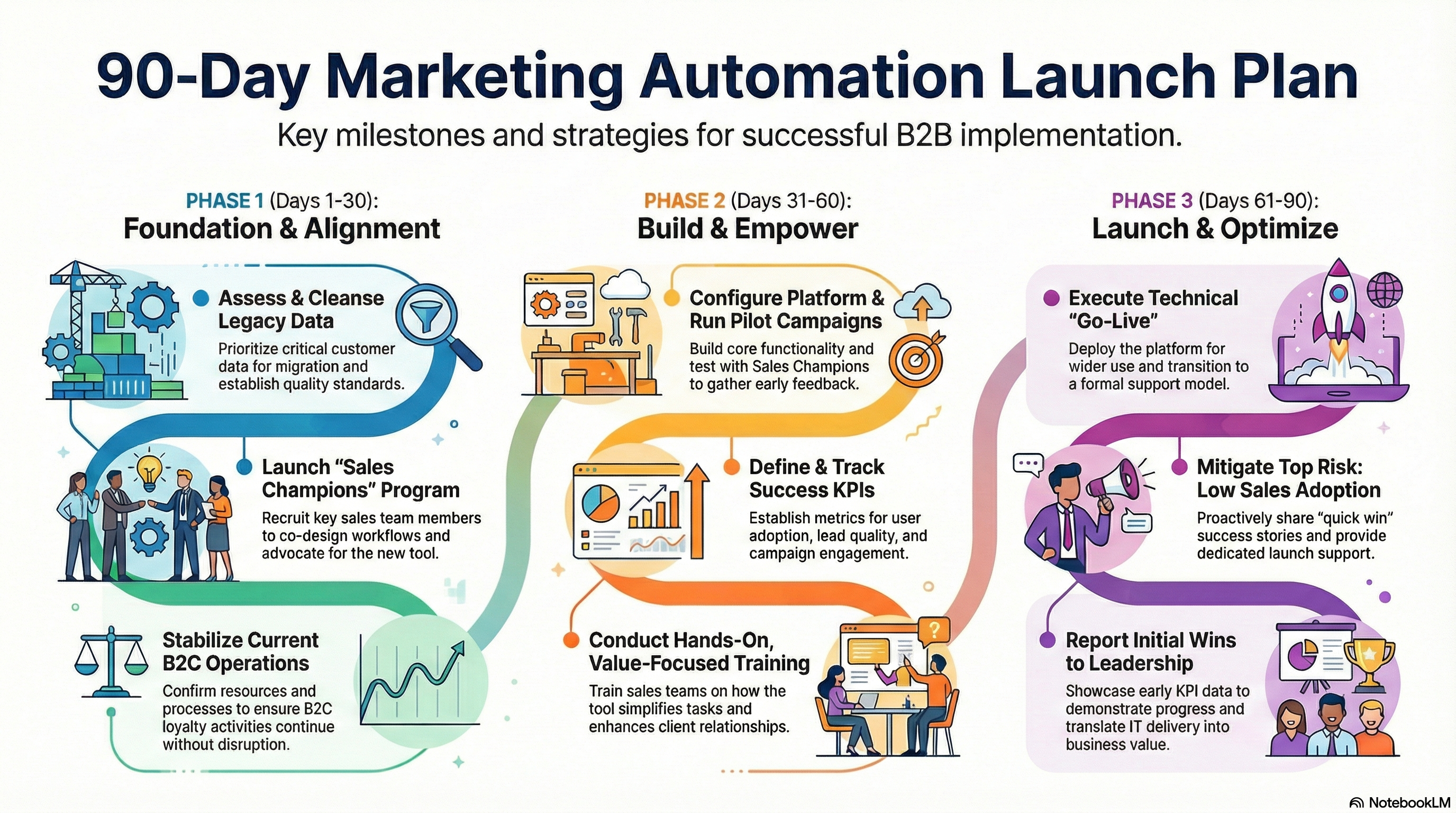
Check out this 90-day Marketing Automation Launch Plan Infographic — the operating model behind this approach:
 Quest for ROMI
Leave a comment